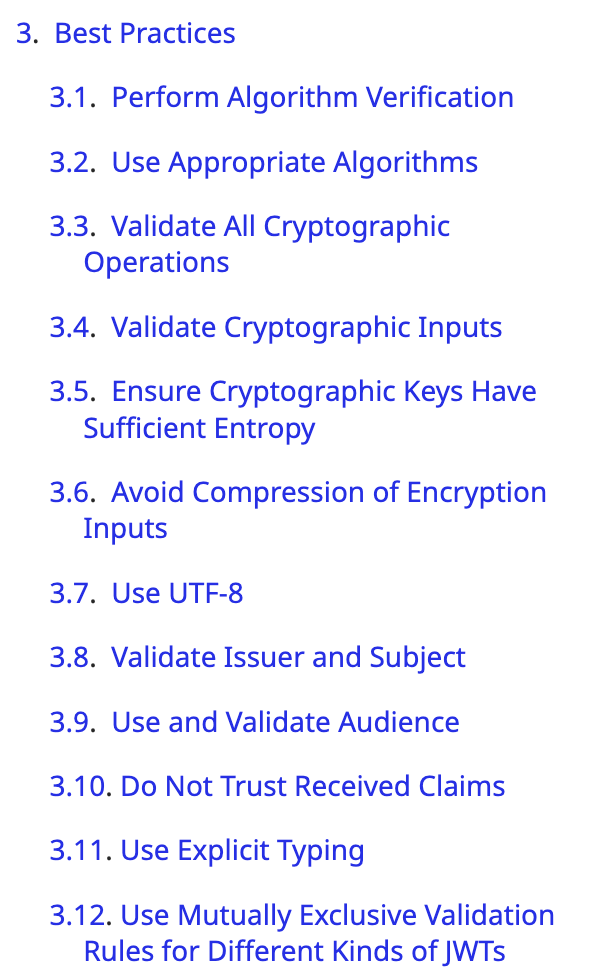
Table of contents:
- 3.1 Algorithm Verification
- 3.2 Use Appropriate Algorithms
- 3.3 Validate All Cryptographic Operations
- 3.4 Validate Cryptographic Inputs
- 3.5 HMAC Key Entropy
- 3.6 Avoid Compression
- 3.7 Use UTF-8
- 3.8 Validate Issuer and Subject
- 3.9 Validate Audience
- 3.10 Do Not Trust Received Claims
- 3.11 Explicit Typing
- 3.12 Mutually Exclusive Validation
- RFC 8725bis (2026)
- Final checklist
- What’s next
We’ve been attacking. Now - how to defend. RFC 8725 (JSON Web Token Best Current Practices) lays out fifteen JWT security rules: twelve original and three from the 2026 bis update. A compact document: do this, don’t do that. In my experience, most applications violate at least one rule. And for most of those violations there’s a CVE we’ve already covered.
3.1 Algorithm Verification
Rule: the library MUST allow specifying acceptable algorithms server-side. Each key maps to exactly one algorithm. Never trust alg from the token header.
Attack prevented: algorithm confusion (article 4) and alg:none (article 3). If the server pins algorithms=["RS256"], swapping to HS256 or none is impossible.
CVE: CVE-2015-9235 (jsonwebtoken), CVE-2026-22817 (Hono, 11 years later!), CVE-2024-33663 (python-jose).
# CORRECT
jwt.decode(token, key, algorithms=["RS256"])

# VULNERABLE - algorithm taken from the token
header = jwt.get_unverified_header(token)
jwt.decode(token, key, algorithms=[header["alg"]])
3.2 Use Appropriate Algorithms
Rule: use only current algorithms. none - don’t use. RSA1_5 (RSAES-PKCS1-v1_5) for JWE - don’t use.
Attack prevented: alg:none (article 3), Bleichenbacher oracle on RSA1_5 (article 10), nonce reuse in ECDSA (article 9).
2026 recommendation: EdDSA for signatures (deterministic nonce eliminates nonce reuse - article 9). ECDSA - only with deterministic nonce per RFC 6979 (best practice from article 9, not an RFC 8725 requirement). RSA-OAEP for encryption (resistant to Bleichenbacher).
3.3 Validate All Cryptographic Operations
Rule: Nested JWT (JWE inside JWS or vice versa) requires validation at every level. Decrypted a JWE - verify the signature of the inner JWS.
Attack prevented: authentication bypass via nested tokens.
CVE: CVE-2026-29000 (pac4j-jwt, CVSS 10.0) - decrypted JWE, inside was a PlainJWT with alg=none. Signature was never verified. Authentication as any user. One layer of nesting - and the entire security stack collapsed.
3.4 Validate Cryptographic Inputs
Rule: for ECDH-ES you MUST validate that the point from epk lies on the correct elliptic curve.
Attack prevented: Invalid Curve Attack from article 10. Without validation, an attacker substitutes a point from a weak curve, and over dozens of requests recovers the private key via CRT (Chinese Remainder Theorem).
CVE: affected go-jose, node-jose, jose2go, Nimbus, jose4j (all in 2016-2017). Check: y^2 == x^3 + ax + b (mod p) for every incoming point.
3.5 HMAC Key Entropy
Rule: an HS256 key MUST be at least 256 bits from a CSPRNG. Human-readable passwords are FORBIDDEN.
Attack prevented: GPU brute-force (article 7) and hardcoded secrets (article 17).
# Correct: 256 bits of entropy from CSPRNG (64 hex chars = 32 bytes)
python3 -c "import secrets; print(secrets.token_hex(32))"

# Wrong
JWT_SECRET="password123"       # hashcat finds it in seconds
JWT_SECRET="notfound"           # CVE-2025-20188, CVSS 10.0
JWT_SECRET="your-256-bit-secret"  # jwt.io default
hashcat on an RTX 4090: ~4 billion HS256 per second (mode 16500). The string “secret” against the rockyou.txt wordlist - instant. 32 random bytes from a CSPRNG - never.
3.6 Avoid Compression
Rule: don’t use "zip":"DEF" in JWE.
Attack prevented: side channel via compressed ciphertext size (analogous to CRIME/BREACH, but at the JWE payload level, not TLS). Practical risk - decompression bomb: an attacker creates a JWE with data that compresses by a factor of thousands, the server decompresses it and exhausts memory (more details in 3.15 bis).
See zip in a JWE header - that’s a finding for the report.
3.7 Use UTF-8
Rule: only UTF-8 for encoding the JOSE Header and JWT Claims Set.
Attack prevented: parser differential via different encodings. If one component encodes the header in UTF-16 while another expects UTF-8, the signature is verified against one set of bytes while the payload is interpreted from another. Recall the Unicode traps from article 2: Cyrillic “a” and Latin “a” are visually identical but are different characters to the parser.
3.8 Validate Issuer and Subject
Rule: the server MUST verify that the signing key belongs to the specified iss. Without this, an attacker signs with THEIR key using "iss":"auth.megabank.example", and the server accepts it. The sub claim must also be validated: format, user existence, and consistency with the request context.
CVE: CVE-2026-23552 (Apache Camel camel-keycloak, not Keycloak itself) - cross-realm tokens. Camel didn’t verify the binding of iss to specific keys. We covered this in article 12.
3.9 Validate Audience
Rule: a token for Service A must not be accepted by Service B. The aud claim MUST be verified.
Attack prevented: cross-service relay from article 12. The most common RFC 8725 violation - in my experience, roughly 65% of applications don’t check aud.
jwt.decode(token, key, algorithms=["RS256"],
    audience="https://api.payments.megabank.example")
3.10 Do Not Trust Received Claims
Rule: kid, jku, x5u and other header parameters are attacker-controlled. Sanitize them, don’t follow blindly.
Attack prevented: all attacks from articles 5-6. kid - SQLi, path traversal, command injection. jku/x5u - SSRF + key substitution. CVE-2018-0114 (node-jose) - trusting JWK from the header. CVE-2026-27962 (Authlib) - same mistake, 8 years later.
3.11 Explicit Typing
Rule: use the typ header to distinguish JWT types. An Access Token MUST have typ: "at+jwt" (RFC 9068).
Attack prevented: token confusion from article 12. Without typ, ID Token and Access Token are indistinguishable. An attacker substitutes one for the other.
3.12 Mutually Exclusive Validation
Rule: when a single IdP issues access, ID, and refresh tokens, validation rules must guarantee mutual exclusion. You can’t use a single verify_token() function for all token types.
Attack prevented: a refresh token gets accepted as an access token. Or vice versa.
RFC 8725bis (2026)
A standards update. Three new rules for attacks discovered after 2020, plus changes to two existing sections:
Update 3.1: algorithm allowlists MUST be case-insensitive ("rs256" vs "RS256" - both must be handled the same way). The blocklist approach is prohibited - allowlists only.
Update 3.12: mandatory typ checking added for separating JWE and JWS. Defense against format confusion: a JWE-wrapped PlainJWT must not be accepted as a signed JWT (CVE-2026-29000).
3.13 Limit PBES2 Iterations. p2c in JWE defines the number of hashing iterations. An attacker sets p2c=999999999 - the server goes into CPU exhaustion for minutes. CVE-2023-52428 (Nimbus), CVE-2022-36083 (jose/panva). Limit: no more than 1,200,000 iterations (2x the OWASP recommendation of 600K for HMAC-SHA-256).
3.14 Check JWT Format Type. JWT in compact serialization contains only A-Za-z0-9-_.. Curly braces, quotes, and other characters in Base64url parts - reject. Defense against format confusion: substituting JSON instead of Base64url.
3.15 Limit Decompression. JWE with zip and no limit on decompressed data size - decompression bomb. CVE-2024-33664 (python-jose), CVE-2024-21319 (System.IdentityModel). Limit: 250 KB for decompressed payload.
Final checklist
Check every item. An unchecked item = an attack vector.
Warning: RFC 8725 doesn’t cover all aspects of JWT security. Token storage (article 13), key rotation (article 17), revocation - these are outside the scope of the standard but critical during real pentests.
RFC 8725 (sections 3.1-3.12):
- 3.1 alg pinning server-side (
algorithms=["RS256"]), alg from the token is ignored - 3.2 no none, no RSA1_5, only current algorithms
- 3.3 nested JWT: signature verified at every nesting level
- 3.4 EC point validation: incoming point lies on the declared curve
- 3.5 HMAC key >= 256 bits from CSPRNG, not a human password
- 3.6 no zip in JWE (side-channel + decompression bomb)
- 3.7 UTF-8 only for JOSE header and claims
- 3.8 iss bound to specific keys, sub validated
- 3.9 aud checked - specific URI, not a wildcard
- 3.10 kid/jku/x5u sanitized, not trusted blindly
- 3.11 typ checked (at+jwt for access tokens, RFC 9068)
- 3.12 token types separated: refresh ≠ access ≠ ID token
RFC 8725bis (2026):
- 3.1+ algorithm allowlist case-insensitive
- 3.12+ typ mandatory for separating JWE/JWS formats
- 3.13 p2c limit <= 1,200,000 for PBES2
- 3.14 only valid Base64url characters in compact serialization
- 3.15 JWE decompression limit <= 250 KB
Outside RFC 8725, but critical during pentests:
- exp/nbf/iat checked (
verify_exp: True- don’t disable it) - token not in localStorage (HttpOnly cookie or Authorization header)
- keys rotated, kid for versioning (article 5)
Most common violations on real engagements: aud unchecked (~65%), weak HMAC secret, missing typ, disabled exp verification. Full testing methodology - article 16. Tools for each item - article 15.
What’s next
The series finale. In the next article - what awaits JWT in the future. Post-quantum cryptography: ML-DSA signatures at 2.4 KB that don’t fit in a cookie. SD-JWT - selective disclosure. And the series wrap-up: key takeaways from twenty articles.